Invoice vs Receipt: Differences, Examples, and Partial Payments
What is the difference between an invoice and a receipt?
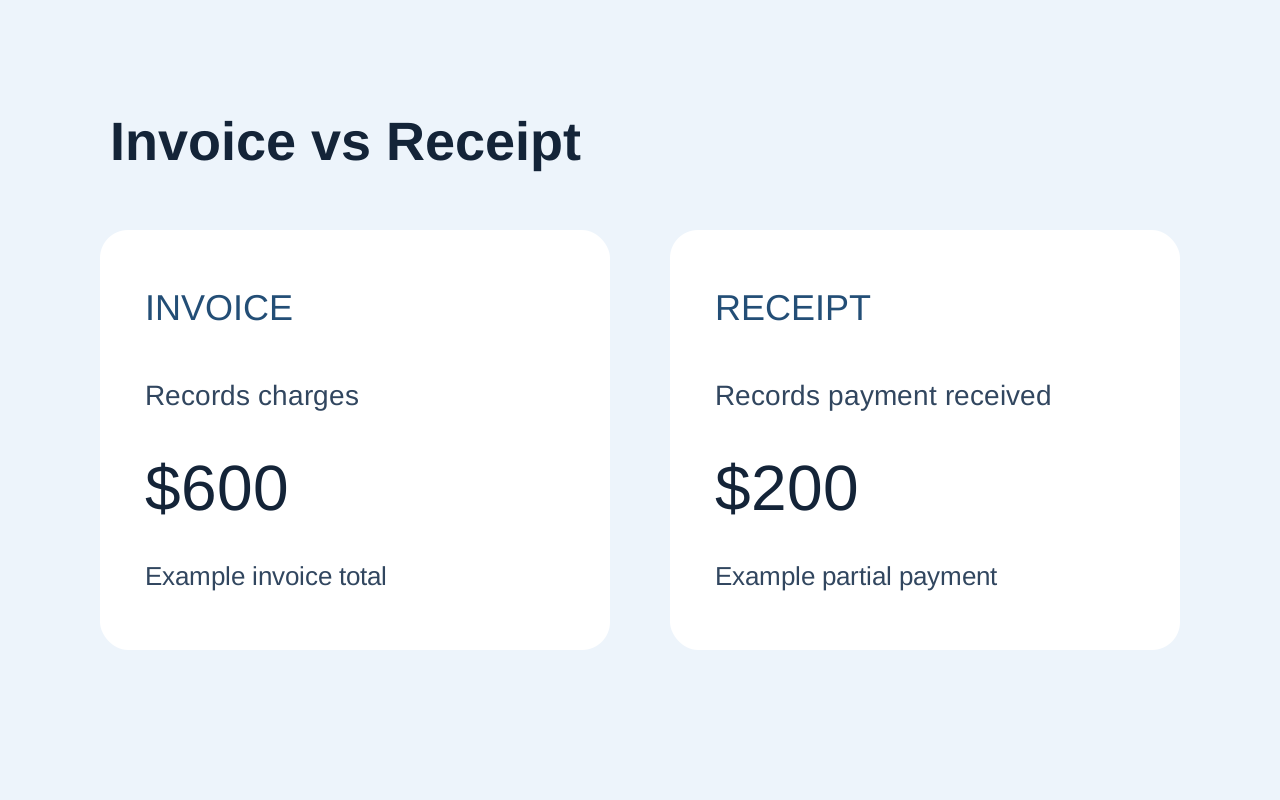
An invoice records charges and the amount due. A receipt acknowledges a payment received. An invoice listing goods or services is not, by itself, confirmation that the customer has paid.
The functions can overlap: when a customer pays at the time of sale, one document may include both invoice and receipt information. Read what the document records rather than relying only on its title.
Invoice vs receipt at a glance
| Question | Invoice | Receipt |
|---|---|---|
| What does it record? | Charges, adjustments, and amount due. | A payment actually received. |
| Which date matters? | Issue date and agreed due date. | Date the payment was received. |
| Which reference connects records? | A unique invoice reference. | A receipt or transaction reference linked to the invoice where relevant. |
| Can the amount be partial? | It can show a remaining balance. | It can acknowledge only part of an invoice total. |
Example: a $600 invoice paid in two parts
Suppose you invoice $600 for completed design work, with no tax, discount, or shipping in this illustration.
- Issue the invoice: INV-2026-014 lists $600 in charges and the agreed due date. At this point, no payment has been received.
- Receive $200: acknowledge the $200 payment with its date and a reference to INV-2026-014. The balance is $600 − $200 = $400.
- Receive the remaining $400: acknowledge this second payment separately. Total received is now $600 and the remaining balance is $0.
The first payment record should not say that all $600 was received. Keep the original invoice and both payment records connected so someone reviewing them can follow the amounts.
What information helps identify a receipt?
- The business receiving the payment and enough detail to identify the purchase.
- The amount and currency actually received.
- The payment date and a receipt or transaction reference.
- The related invoice number, when payment is for an invoice.
- The payment method and remaining balance where useful, without exposing full card or other sensitive account details.
This is a practical record-keeping checklist, not a universal statutory format. Use your payment provider or accounting process to issue the appropriate receipt for your transaction.
Does marking an invoice Paid make it a receipt?
A paid annotation can communicate the status you have recorded. It does not independently verify a transfer or replace all receipt requirements. Confirm the payment against your own payment records before acknowledging it; do not treat a promise to pay as money received.
In this invoice generator, Paid is a manually entered amount. Entering $200 against $600 in charges reduces the balance to $400. The tool does not process payments, verify funds, or generate a separate receipt. Renaming the document does not add those functions.
Use the right document in your workflow
Use the invoice editor to describe charges, set dates, and download an invoice PDF. Use your payment or accounting records to acknowledge receipts. For the invoicing steps, read how to make an invoice. For references that connect the documents, see invoice numbering examples.
If your invoice includes a deposit already received, the freelance invoice example shows how that payment affects the balance. Keep any separate payment acknowledgement alongside the invoice.
Sources and local requirements
Australia's business.gov.au receipt guidance explains that an invoice can also serve as a receipt when payment happens at the sale. Its invoicing guidance describes invoices and their role in requesting payment. These are Australian sources; check the requirements that apply to your own location and transaction.